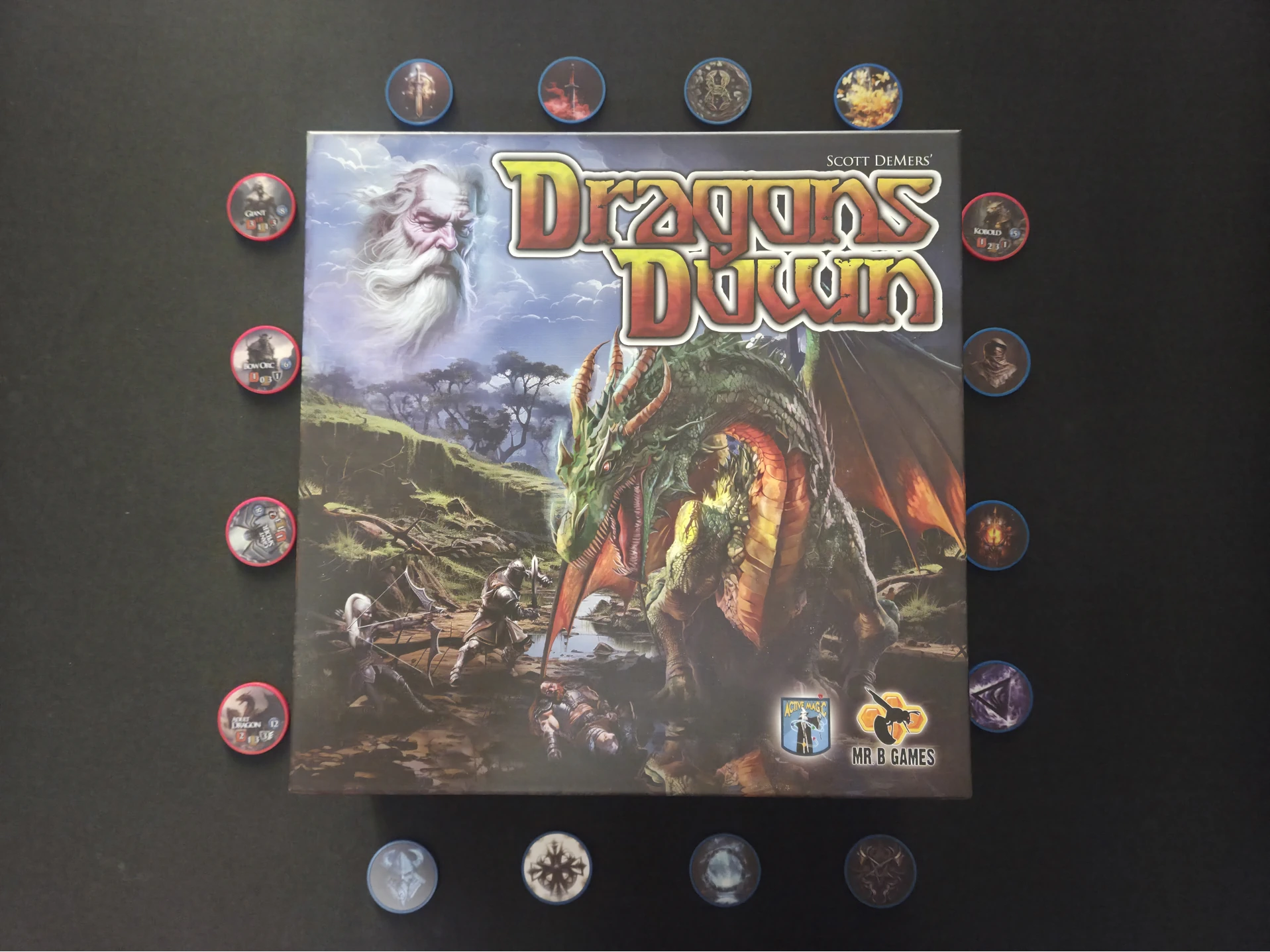
Dragons Down - Review
By Danilo Spinella • 15 minutes read •
Table of Contents
- Being hunted by monsters in a land of pure luck
- Gameplay
- The adventure
- Art and production
- Conclusion
| Players: 2–4* | Play time: 120-240min | Category: Sandbox |
|---|
Up to 6 players with the expansions.
Being hunted by monsters in a land of pure luck
How to describe Dragons Down? It's big, massive, and it attempts to reach a new level of sandboxing, mimicking its predecessor, Magic Realm . At its core it's a fantasy roleplaying game, where you start by choosing your lineage and class, and depart to find fame and glory, finding items, and hunting monsters. No, literally — you depart to find Fame that will lead to Legend Points, the victory points of the game. It's not meant to be balanced, but it has to be taken as an experience; you will adventure through these wild lands, and, as any good adventure, you don't know where you're going. These lands are dangerous, to the point where the death of your character(s) is not only contemplated, but even featured in the rulebook.
Will you be able to find glory? More importantly, will you manage to survive these harsh lands? Be sure to bring a lucky charm, because things are rough in Dragons Down.
Gameplay
The rules will not be explained in full in order to keep this review concise. Be sure to read the rulebook or watch the How to play video (the only one at the time of writing) to learn about all edge cases and rules not covered here.
Let's start with the gameplay and mechanics first, as they only serve to create the experience, which we are going to discuss extensively later.
:strip_icc()/pic7470609.png#end)
Each player controls one character, and every character has a lineage and a class. A lineage could be a Human, a Dwarf, an Elf or the likes, as Dragons Down doesn't shift from the classic Fantasy setting. The lineage gives your character one unique ability, which will be very useful during the game, as well as some partial stats. On the other hand, the class gives your character the starting items and most of its stats. Dragons Down has the classic Intelligence, Wisdom, and Charisma — too bad they're used in just 2 different occasions throughout the game: to make haggling easier when we want to buy from a merchant, or to get more points when solving quests. Given that we have no idea what quests we will see, they are not very useful overall. However — and here comes the best part — instead of Strength and Dexterity, there are different cubes given to your character: mighty cubes, used for dealing damage during combat; speed cubes, which are used to determine how fast you want to attack/evade; spell cubes, which come in all sorts of colors. In addition, there are life points and two very important tracks: attack speed and maneuver speed. These two starting cards are the most important choice of the game. Build a character that is not well prepared, and you will die easily. This also means that some combinations are easier than others, and that you should only experiment after a couple of games or more.
It's time to take action
In Dragons Down there are just a bunch of available actions you can do; they are all thematic, and you can do up to 4 per turn. For example, you can Move through the various zones, though mountains will be harder to traverse and therefore more expensive in terms of movement points, costing 2 of your precious 4 movement points you get every action; passing through caves or even starting your movement in a cave will slow you down, making you lose one movement point per action. You can Search to activate a hidden passage in your zone, enabling fast movement between two distant zones, which is crucial if you don't want to spend turns just going around. Search is used to find a Site in your zone, if your tile / zone contains one, enabling you to Loot, which is another action, and grab whatever treasure might be there. As you can see, all actions are thematic and have some specific rulings to give the feeling of living in a fantasy world.
Almost everything is done by rolling dice, and the default rule is that we throw two dice and get the worst result. In other games this is called disadvantage, and here in Dragons Down we spend our entire game playing at disadvantage. Do not lose hope, though — even monsters have disadvantage when they throw, so they will still pick the worst result for them. This world is truly unforgiving. There are a few ways to mitigate the dice, depending on which action you are doing. If you do a Search action, you need to get a "found" face on the dice; we are at a disadvantage so we throw two, and if we get even just one blank, we failed. However, you can keep one symbol if you do another Search action on the same turn. So probably in 2-3 actions you will have found whatever you are searching for, but you need to start your turn with a Search action, and probably use it all just for that.
Speaking of the map, it's a hexagon-based one, with each tile containing multiple zones inside, where your character will actually move. There are different terrain sets (Plains, Mountains, and Caves) in the base game, and each comes with its own hexagons: 5 wild tiles with 6 different zones inside, and 1 civilized, with just 4 and a fortress for the natives, the inhabitants of the land. The map is built anew every game, either by exploring it or by creating a layout during setup, so there is a lot of replayability in that. Either way, you need to set some personal goal or objective for your character, because movement is restricted and you'll probably struggle a lot with it, as the map is big. I actually liked the map, though it's a little bit generic, outside of assigning types to the different zones (mountain, cave, etc.). What is actually random on the map? Just a single token you draw randomly the first time any player explores a tile; this token can represent a site — meaning you need to draw a site for the current terrain type and put it in its corresponding zone — a gate connecting to another gate in some part of the map, or it can simply be empty. That's the only random thing on the tile, which is quite weak.
The native fortresses are just one in each set, and if you want to buy/sell something or to get a quest, you will need to visit them. Probably multiple times every game. Every fortress comes with its own inhabitants, which is nice at least. Outside of that, and the different merchants you will find, there aren't many differences. The quests will be drawn from the same deck, same for the items at the merchants. The only difference between merchants will be the statistic that helps you haggle the price of the items. By default all items available in a merchant can be bought by paying 3x the printed price, during a Trade action. However, you can reduce the price by Haggling: you throw the dice (at disadvantage here too) and you need to get the same value as your attribute, or lower (e.g. a value of 2 if you are checking Charisma and your character has 2 symbols). If you lose, you can try again with another action on the same turn — except if you get a closed-door symbol, where the merchant is irritated with you and doesn't want to make any deal until the next turn. Yes, if it wasn't clear by now, Dragons Down is a push-your-luck game, and a very punishing one at that.
Loot, loot, loot
One of the most interesting parts of the game is the items, of which there are a ton. The way to get them is through the merchant or by doing the Loot action in a site (disadvantage here too!). These items vary a lot — they can be all kinds of swords, axes, or even magic items that can give you spell cubes. It's always exciting drawing new items, hoping to get something good, and then adapting your build to the new loot. On the other hand, if you find an Epic item, you will get one Legend Point and five Fame for free, just because you were lucky. I think this is one of the points that detracts the most from the experience. Why did I earn that? Just because I was lucky enough to pull a good item? Sure, in the sites there are Deep Treasures that have more Epic items, but then the game becomes a hunt for Epic items. That's how my game went: I was just looting good stuff, I earned a lot of points, and I was able to arrive second by one point — even though my character died halfway through.
Adapting your build is also said to be one of the most fun parts, at least according to players who have played a lot. What do you do with a magic staff when you are a Knight? Oh wait, that tome gives you a purple spell cube; that scroll lets you learn a magic spell; maybe I can learn this one that only costs two purple cubes. I'd say this is where Dragons Down actually shines the most. You need to do your best with what you've been given, considering also your starting lineage and class (which give basically all your character statistics).
Hey, don't eat my breastplate!
These wild monsters are wandering around, looking for players to kill — so how do we fight them? The combat in Dragons Down is one I have never seen before, and it's very interesting on paper. The mighty cubes are used on weapons to choose how hard you are hitting; the speed cubes decide how fast you are hitting and how fast you are evading the attack. However, only 5 cubes at most can be used in a combat round. All monsters also have the same 3 statistics printed on them, so you know how fast they are attacking and how fast they are evading. However, you throw the dice at the start of each combat round to determine if an enemy will change its pattern — in other words, change its face. You can look at both before deciding how to assign your cubes, but you need to consider what happens if the monster changes its pattern or not.
Now comes the difficult part: how to resolve combat. These statistics are intertwined — first you need to look at the speed of both attacks; whoever has the highest goes first. If there is a tie, then check the length of the monster's attack and of your weapon. Then, whoever goes first needs to check their speed against the maneuver of the enemy, and if it is higher, the attack is a success. If it is not, dice will be thrown, with a better chance of success if the speeds were the same. Perfect, your attack was a success. Now you need to take into account the armor of the monster: is the damage enough to kill it? If that's not the case, you have only inflicted a single wound, no matter how much damage you did. The monster then attacks — same thing as before, but reversed. If it hits you, you will either die or take a wound. Taking a wound means moving a cube (which also includes your hearts) to the wounded space. The more wounds you take, the less functional you are during combat, meaning you will take more wounds, and so on. You can use your armor to defend and avoid dying, but the armor might be destroyed if the attack was stronger than its defense value. If the attack and the defense are the same, then the armor gets damaged, and you still take a wound. This continues until either the monsters are dead or you die — or, if no one gets hit in two rounds, it also ends. At least you get some Fame from the monster when you win!
When do the monsters spawn? When all players have played their turn, then there is the monster activation phase and combat. You throw the summoning dice and see if any symbol matches a tile where a player is standing. If they match, then you get a monster summoned on your zone. Right after that, it will attack you. You can try to hide (which is not evading), but you need to throw dice for it. This is where the most important action of the game comes from: Sneak. By sneaking, you can ignore one symbol on the two dice thrown to try hiding. Most of the time you will get away with it if you do a Sneak, but that also means your 4 actions are instead 3 actions plus a Sneak. This is very random — you can build a story of encountering monsters like that, but it's still very bland in my opinion.
If you are hidden during a combat, and have a ranged weapon, you can do an ambush and attack the monster. You still need to throw dice every combat round to see if you remain hidden. What if you want to run? Then you need to have a higher maneuver speed than the highest maneuver speed of the enemies; that can be quite difficult if your character has only limited space available in the maneuver track (I am looking at you, Knight!). That means if you encounter three enemies at once, your chances are very slim. If you can't even escape, then consider your character dead. At the same time, there are some characters — like the Rogue — that have such a high maneuver speed that they can escape most monsters, avoiding virtually any fight. It means that character will go on evading monsters the whole game, just grabbing loot, and maybe making more Legend Points than the others.
The adventure
The lack of any type of event is astonishing. I have been playing a campaign of Arydia, and every time you travel you draw one card; depending on the symbol on the road and the card, some things might happen. I would have loved to have something similar for Dragons Down — something to make the game more dynamic outside of visiting new tiles and spawning monsters. Something that makes the game feel like an adventure, where random events might happen: you might encounter some NPCs with weird offers, a wandering merchant, or you might even be given a quest or a choice to fight some monsters to help a person in danger. Yet, all that the adventure of Dragons Down amounted to, for me at least, is a long slog of traveling through sites, hoping to draw some treasure that gives you points, and avoiding fights if possible.
One way to end playing with a character is to retire, but only when you are in a civilized location. By retiring, you count all the Legend Points you made, transform Fame into Legend Points at a 10:1 ratio, and — if it is the last turn — get one more Legend Point.
The death mechanism, on the other hand, puts a hard reset on your game. You only get to keep half of your hard-earned points. Then you take a new character and depart on a new adventure; if it happens after one third of the game, it will be very hard to get back on track, basically making you lose the game. Dragons Down has to be played for the experience, and the death of a character definitely gives you a story to tell. But at the same time, it might feel like the conclusion of your game and time to pack up — or time to wait for the others to finish the game. This is punishing just for the sake of it. A quick solution would be to have an inheritance system, where you either get all the items you collected or half of the victory points your deceased character had. That way, dying would still sting, but at least it wouldn't reset your game.
One thing that might seem interesting at first is the Quests, which can only be taken at the fortresses, from the merchant; you can have a maximum of two quests active at once. The quests are very bland — they contain just brief instructions, no lore or story to hook you in, and the reward itself is just Legend Points depending on your and the quest's attribute. From a game that is all about the experience, I expected a little bit more, unfortunately. Some quests also reward you with an Outlaw token, meaning that you have done something bad. Is it good? Well, when your adventure finishes and you retire, you will throw the dice — it can either give you a Legend Point, take one away, or just... nothing.
Art and production
The art has been made with AI, and that is easy to spot. I am not particularly against AI — though I prefer human-made art, AI can help in cases like Dragons Down, where commissioning art for the entire game would cost so much that we might not have a game at all. However, the art is too generic and lacks life; it lacks an identity. All the characters are generic fantasy tropes, and the monsters, too, can be found in any fantasy literature — there isn't even one case where the game tries to add something more. The cards, which should be the core of the game, don't give you the same excitement when you pull them, because they aren't as cool-looking as you'd expect. The iconography works but it's generic, and could have been more descriptive.
On the other hand, the monster fiches are awesome — they take the exact amount of space they should, taking into account all the information there is on them. It's quite fun to move them around when they spawn or when they are following you, as well as seeing them in front of your character fighting. The rest of the components are functional and work well.
Conclusion
I had a rough time tracking down a copy of Dragons Down. The game has only ever been available through Kickstarter and through the few merchants who grabbed a copy. Even buying it used, the price was the same as a new copy — if you could manage to find somebody selling it. It's a rare game, and it will probably always be, considering its nature. Its rarity only added more hype and FOMO for me. The designer put a lot of effort into it, and you can feel his passion. You can even reach out to him on BGG, where he will gladly answer any question you have about the game. He's also published a roadmap for new content, and the plan is to release tons of it. Maybe the expansions will fix some of my issues.
Dragons Down takes the legacy of its predecessor, Magic Realm, and tries to bring the same, or even an improved, experience to the 21st century. Its world is vast, and, as a true sandbox, offers a multitude of ways to customize your experience — going from an adventuring game to an exploration game, throwing spells and weapons against monsters. The game mechanics are deep and complex; there are still tons of rules I didn't mention in this review, like how ranged damage works (you throw more dice that go from -2 to +2), Undead, how Spells work (you use your cubes to activate them at the start of the combat round), Flying, or how to enhance a tile. There are also tons of optional rules, like PvP and Luring monsters. However, it is too complicated and too faithful to how an actual fantasy world would work, for its own good. Playing the first game and teaching it is work, and you need to be well prepared and power through. I had fun, yes. However, after thinking about it later, I realized I had spent more time learning and teaching the game than actually playing it. It might be a good solo option, or a lifestyle game for people willing to commit to it, but I will never bring this out to play as a one-shot with new players, if they aren't interested in playing again.
Another big issue of Dragons Down is that the game mechanisms are interconnected with rules that refer to other rules, which is usually not only okay, but a good sign of good design. However, all the mechanisms here are full of edge cases that you need to remember and consider when playing, and since everything is so interconnected and convoluted, it quickly becomes hard to play. Add the messy rulebook, and it quickly becomes a disaster. In my playthrough, I had to go back and forth through the rulebook for at least half of our three-and-a-half-hour play session. If I'm reading about what token to place, I don't want to go back to the start to find a small paragraph where this is properly explained — I'd at least like a reference to the page.
The game is big and had all the premises to bring nights of fun ahead, thanks to its sandbox structure and unique gameplay. However, what I found was a messy rulebook, a stretched-out night, and a punishing game. What you need the most is to be lucky: lucky to find rare treasures that will boost your fame, lucky to not encounter 3 monsters at the same time, and lucky to understand the rulebook after a single read.
The verdict
The game is a work of passion, but unfortunately doesn't manage to live up to its own hype. Some mechanics are interesting, such as combat and spells, and its replayability is top-notch, but the game itself needs to be streamlined to be snappier and focus more on the adventure rather than the edge cases and complexity of the mechanics. It also needs more dynamic events to stray from the classic, and a bit boring, monster summoning.