Dragons of Etchinstone - Review
By Danilo Spinella • 4 minutes read •
Table of Contents
Overview
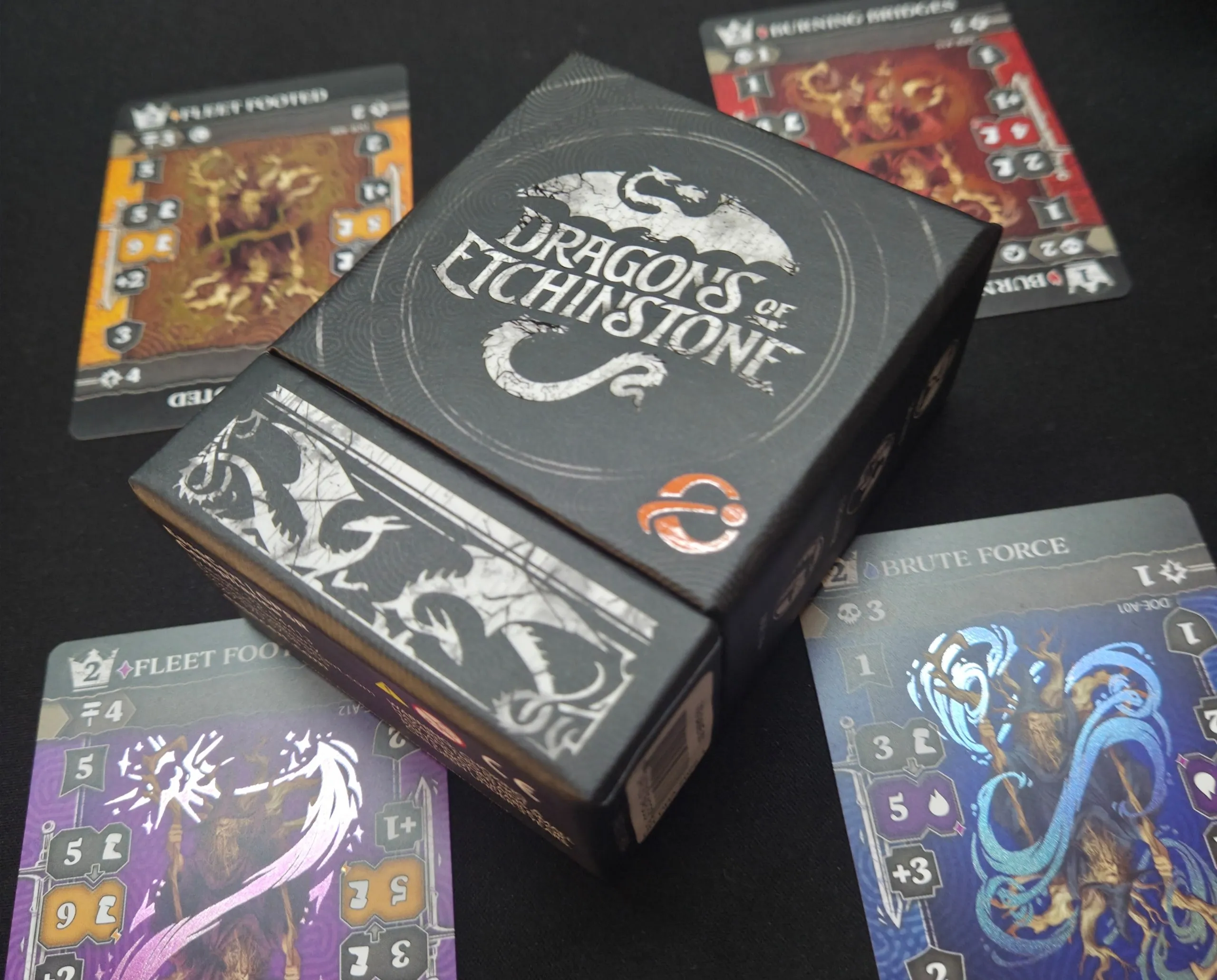
:strip_icc()/pic9316638.jpg#start) Dragons of Etchinstone is a solo game that puts us against an ever-growing
horde of enemies, while our wizard travels treacherous and perilous paths
toward a single goal: facing one of the dragons of Etchinstone, the boss that
we face at the end of every game. The system revolves around four cards in
hand, to be played carefully in order to make the most of the spells at our
disposal.
Dragons of Etchinstone is a solo game that puts us against an ever-growing
horde of enemies, while our wizard travels treacherous and perilous paths
toward a single goal: facing one of the dragons of Etchinstone, the boss that
we face at the end of every game. The system revolves around four cards in
hand, to be played carefully in order to make the most of the spells at our
disposal.
Published in 2022 and initially available only in Print & Play format, Dragons of Etchinstone received a new edition last year published by Chip Theory Games, backed by a Gamefound campaign. The new edition leaves the original gameplay completely untouched, but brings a fresh and striking visual identity that allowed the game to reach a much wider audience. And it is this edition we are reviewing today.
Dragons of Etchinstone belongs to the microgame category: games made entirely of a small number of cards, usually 18, and therefore easy to print at home. Among the most well-known and commercially successful publishers in this space is Button Shy Games.
Gameplay
The rules will not be explained in full in order to keep this review concise. If you want to learn the rules before diving into the review, you can use the rulebook, the official video tutorial, or the interactive tutorial on Dized.
The flow of Dragons of Etchinstone is very linear: each turn we will face either an enemy or a journey. The choice between the two is determined by the top card of the deck, called the key card, and the region we are currently in. Since we draw 3 or 4 cards each turn, the top card will always be different, and with it the challenge we face; some games will have more journeys than enemies, and vice versa, which makes it important to build a deck capable of handling both, as challenges will grow in increasing difficulty throughout the game. Each enemy or journey can have its own modifiers, and the key card can add further ones, always negative.
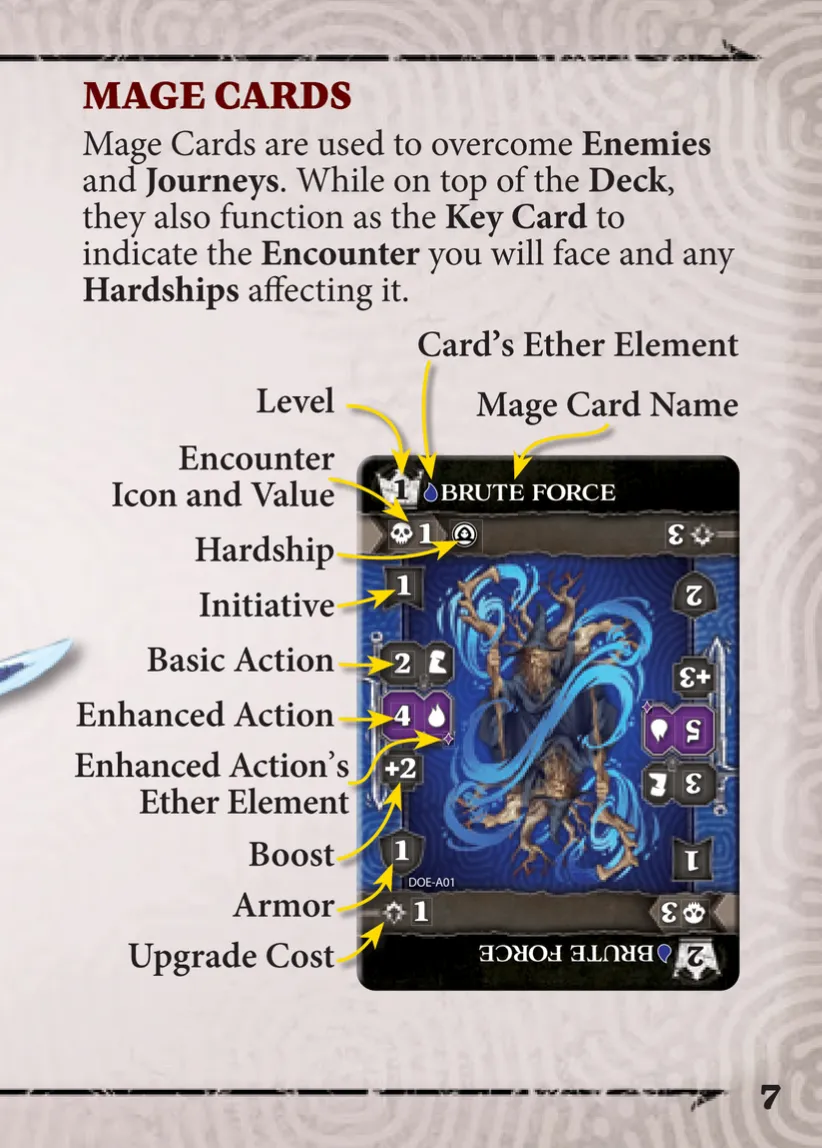
Let's talk about the heart of the game: the cards. Each challenge gives us 4 or fewer cards to activate our spells. Every card is packed with information: starting from the level (ranging from 1 to 4), the spell type (boot for journeys, sword for enemies), the element and boost, all the way to the shield. This density of information can feel overwhelming in the first game, but it reflects the spirit of Dragons of Etchinstone, a game that, with just 20 cards, presents a huge number of decisions every turn. Which card do we assign as our spell? Which as our element? If I place this card here, I have enough initiative to avoid the monster's attack, but I don't get a successful victory. But if I instead merge these two cards, I can trigger the enhanced attack, yet my boost ends up one value short and I have one fewer card to use. Having only 3 cards in hand usually means assigning no reserve card, so in this case it also means discarding one extra card.
The sheer number of choices each turn is the game's greatest strength: for example, if we are able to clear a challenge successfully, we can choose to skip it by discarding a card from hand and one from the deck — but risk facing a similar challenge later with one fewer card. As mentioned, the role we assign to each card is crucial, as is the choice of distributing damage at the end of a combat, since sometimes we will be adding modifiers where there were none before, cards will have lower values, and a shield might lose its element entirely (elemental shields block double damage of the matching type). Finally, we can upgrade our spells with the experience points we just earned, and the same considerations about damage distribution apply, only in reverse. Facing 4 regions per game gives us a sense of progression both in difficulty and in the strength of our deck, though not an overwhelming one.
Every game concludes with the final showdown against the dragon chosen during setup. This challenge works slightly differently from those faced during the game: we first use 7 cards to complete the last journey, then all remaining cards to face the dragon. These two challenges deliver on their promise, they feel more epic and will push us hard; moreover, they will be easier or harder depending on how much and how well we have upgraded our deck, reflecting the choices made throughout the game. Having to build two sets for each of the two final challenges makes this the longest and most analysis-paralysis-prone part of the game, but also the most rewarding.
Using the combination of region and key card makes for very diverse and varied games. That said, a second set of regions would have been very welcome for added replayability (something addressed in the Northvale expansion). There are 10 modifiers in total, spread across key cards, enemies, and journeys, a decent number to ensure you won't see the same combinations every game. For the final dragon, Dragons of Etchinstone provides four, one for each element. Unfortunately there is no way to adjust the difficulty other than starting with lower-level cards, which could be a significant drawback, especially considering that the cards will be the same across every playthrough: the game might seem to have a limited shelf life. Saving the day are two variants, Challenge Mode and Adventure Co-Op, each offering different rule sets to choose from, and either one alone would go a long way toward making the game much more replayable. Add the two expansions Northvale and Siege , plus the Adventure Mode and Minimalist Co-op variants that require the Northvale expansion, and the game becomes virtually endless.
As for balance, it is clear that Joe put serious work into the numbers to make everything click and achieve the right difficulty level: many times we will find ourselves facing a challenge we cannot overcome by a single missing value, and that is one of the most accomplished aspects of the game, the part that forces us to think and find a way out even when the math is not on our side.
Production & Art
Be aware that several owners of the first print run have reported that the cards show wear after just a couple of plays, sleeve them before your first game.
On the art side, Federico Pompili truly shines on the dragons and monsters, conveying the menacing atmosphere of the Vale regions with great effect. On the other hand, all spell cards, our entire deck, share the same artwork: the wizard we embody throughout the game. To add some visual variety, different effects have been applied based on the element, with a foil finish that makes them genuinely striking to look at. The box is also very compact and fits all the cards sleeved, though it won't accommodate expansions once those are sleeved too.
On the card design front, cramming so much information into such a small space while keeping everything readable is no small feat, and yet the result is convincing, helped in no small part by the total absence of text on the cards themselves.
During the campaign, a free PnP version of Dragons of Etchinstone was released called Felines of Fetchin' Bone, in which the original artwork is replaced by photos of cats sent in by Gamefound backers. You can find more information and links in the campaign post.
There is also an unofficial Pokémon-themed version: Legends of Kanto, available for free as a PnP.
Conclusion
Designer Joe Klipfel has done it again: in a handful of cards he has built a game that holds its own against titles far larger and more complex. Dragons of Etchinstone is polished in every aspect, from its clean game flow and tight balance to the artwork and the variety of alternative modes. If you are looking for a small and affordable game that will keep you busy for a long time and above all make you think hard, this is the one. Just be warned: it is a numbers-heavy game, and that might put some players off. Moreover, it's a beat your own score game, which mean the standard game might seem samey after a couple of games and some players might not like it.
Final score: 7.5
Similar Games
Finding games truly similar to Dragons of Etchinstone is no easy task, but among Joe's other designs we have Gloomhaven: Buttons & Bugs , another tiny game that in 20 minutes delivers a similar experience to its bigger sibling Gloomhaven, albeit a more distilled one.
Comments
You can comment on this blog post by publicly replying to this post using a Mastodon or other ActivityPub/Fediverse account. Known non-private replies are displayed below.